Blog / 2026 / Mirror versus Funhouse Mirror: Human Art versus AI-generated Content
October 19, 2026
The word count clocks in at over 4500. Not for the post you’re reading right now, mind you, but for Grokipedia’s entry about my art. That’s approximately 4300 more words than Wikipedia’s “Gwenn Seemel” article—and also a fair estimate of the number of errors Grokipedia’s essay contains.
I’m kidding.
Sort of.
Grokipedia is a Wikipedia-wannabe edited not by a community of volunteers, but by the AI program called Grok, which is Elon Musk’s creature. Grok is also the language learning model that’s best known for dubbing itself “MechaHitler,” meaning that Grokipedia isn’t your usual mistake-riddled beige rainbow of AI text. No, Grok’s output has an overtly fascist flavor.
It’s so bad that I wasn’t sure I wanted to even talk about it on my blog—so bad that I refuse to link to Grok’s words about me, because I don’t want to encourage Musk by sending his site any Web traffic. If you’re interested in reading Grok’s problematic text about me, you can download a screenshot here.
All that said, since Musk lost interest in Grokipedia in April and effectively froze the site as a snapshot of one of his many pissing contests with the world, it feels safe to bring it up now.
First things first, I want to be clear: Grokipedia’s entry about me isn’t an honor like Wikipedia’s. In the case of Musk’s site, no human looked at my work and decided that it was worth indexing in a repository of knowledge. Rather, Grok was directed to rip off Wikipedia as much as possible, while also making “improvements,” meaning that my inclusion is just part of Grok’s assignment.
And I haven’t learned much* by seeing what Musk’s creature came up with when it combed through my site and regurgitated its error-filled summary, but one thing stands out.
Artificial intelligence is a funhouse mirror version of our world.
And in that way it’s a little like art.
Because art has always been a mirror. It reflects the times that artists live in and, whether or not they acknowledge it, those artists are responsible for holding up their mirror. What I mean is that they choose what to bring to our attention and they decide on the precise angle from which to show us ourselves.

Rainbow Connection
2024
acrylic on paper applied with wheatpaste glue
5 x 1500 inches
For example, as the 2024 presidential election year got underway, I was focused on a pedestrian bridge near my home that had been repeatedly covered with MAGA propaganda for many months, with little response from local authorities. The mirror I held up to those in charge of maintaining the bridge was angled to show them their own apathy.
I put first bandaids and then rainbows over the hateful vandalism, and I kept doing it until local authorities took the MAGA propaganda seriously. I even reached out to the press to help make my mirror more effective. Eventually, the bridge was returned to its original unblemished wood, and the area was put under surveillance, until the vandal was either caught or dissuaded from returning.
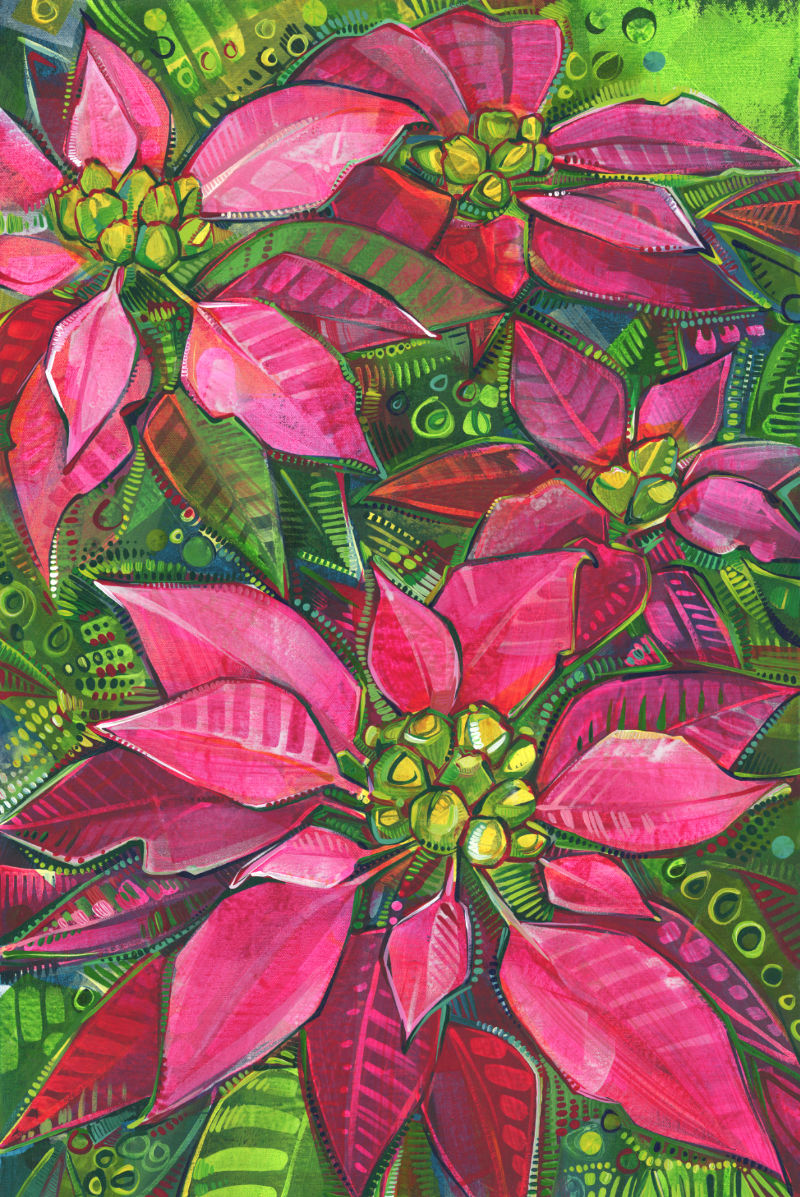
Cuetlaxochitl
2025
acrylic on unmounted canvas
28 x 19 inches
(For greeting cards with this image, go here.)
In 2025, horrified by the current administration’s frenzied and violent obsession with deporting immigrants, I painted, among other things, a cuetlaxochitl. This plant is more colloquially (and colonially) known in English as a poinsettia, named for Joel Roberts Poinsett, who’s credited with bringing this flower to the United States in the 1800s. Of course, that’s not all Poinsett did: he also owned human beings and oversaw the Trail of Tears.
So, last year especially, it felt important to hold up a mirror to this ubiquitous December décor. I wanted to help give the plant back its indigenous name, and I angled my reflection to recast the proliferation of potted cuetlaxochitl around Christmastime as a reminder that a lot of good comes to the US from Mexico and beyond.
This year, out of a desire to show Americans who we really are, I’ve made a bunch of Semiquincentennial art. This time I’m angling my mirror in such a way that the Christian Nationalists currently running the government can’t help but see we disagree with their plans for us. And I’m holding my mirror proudly so that anyone who’s despairing over the state of these United States can see that they’re not alone.
As part of my own 250th celebration, I’ve painted Abe Lincoln, the Statue of Liberty, a bison,and a large female bald eagle along with a smaller male bird.
More recently, I created this image of George Washington. Like Poinsett, Washington owned human beings, making him a less-than-perfect representation of “we, the people,” but my portrait of him emphasizes his role as the original “No Kings” protestor. The US’s first president set an important precedent by limiting himself to two terms in office.
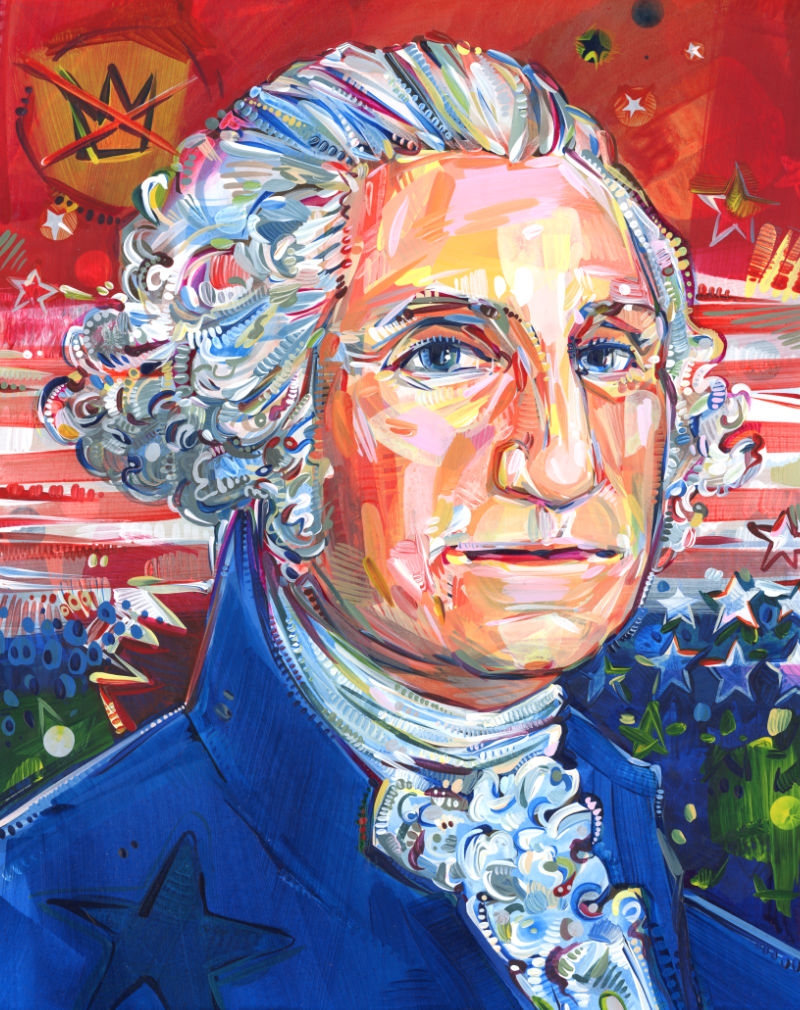
George Washington
2026
acrylic on archival board
14 x 11 inches
(For prints and t-shirts of Washington, go here.)
These are just a few examples of how I call attention to what I think we need to be looking at in a given moment. In each case, I’ve got a specific point of view and I’m unapologetic about it.
Similarly, the people who are attempting to build artificial general intelligence—with programs like Grok, Claude, and ChatGPT—are responsible for holding up a mirror to society. But, unlike the artist’s looking glass, the computer engineers’ mirror is distorted by the convolutedness of their programs. And that means that the funhouse mirror of AI produces garbage instead of art. I’m talking about garbage like:
- all the lies and mistakes that AI spits out and that its engineers have shrewdly dubbed “hallucinations” as a way of dulling their threat. [Ars Technica April 2023; New York Times April 2026]
- the unrelenting solicitousness and sexual responses of their chatbots that lead to dependency and psychosis for many users. [Psychology Today January 2026; Last Week Tonight with John Oliver April 2026]
- the alarming environmental impacts of the data centers that Musk and the rest are building and using to continually train and re-train their AI programs. [PBS News June 2026; More Perfect Union August 2026]
But the garbage can also be infinitely more subtle. In the case of Grokipedia’s article about my art, the best example of it is in how the program describes my decision to place all my work in the public domain. I make my work free for use by anybody, for any reason, without asking for permission first, and Grok goes on at length about how controversial my stance is. Here’s just a snippet of what it says:
“[C]ritics [argue] that forgoing copyright erodes economic incentives by enabling unrestricted copying and commercialization without compensation.”
The hypocrisy of an AI program pointing this out is breathtaking.
Musk and all the engineers behind Grok, Claude, and ChatGPT have trained their programs on the creativity of everyone who’s ever posted anything on the Web. In other words, they’ve given their language learning models the command to copy from us in an unrestricted manner, and they haven’t once voluntarily shared any of the billions of dollars flowing through their industry with us. And yet those same engineers fail to discourage their program from reminding us that copyright is ostensibly about protecting our right to compensation.
Never mind that, in practice, copyright does not do that well—I wrote a whole book about that problem, which you can download for free or with a donation. The people behind AI can’t even feign contrition as they continue to take from us.
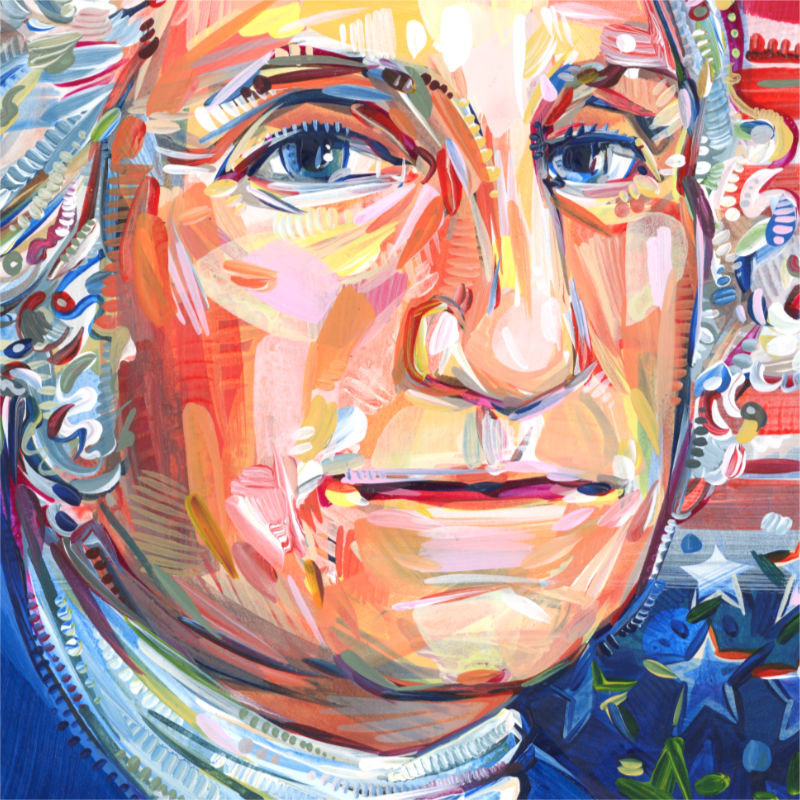
Which brings me back to Washington and the founding of the United States. In 1776, both the affluent and the not-so-affluent among Americans fought against the idea of a king and a noble class whose lifestyle was funded not by working for a living, but instead by simply owning stuff. These oligarchs used their property to extract wealth from workers and tenants, while never producing anything of value themselves, and Americans were done living as serfs.
In 2026, the fight is the same. The current president styles himself a king, and his pet oligarchs, the so-called “tech titans,” are here to extract knowledge and creativity from all of us. The oligarchs are using computer programs to repackage our human intelligence and then leverage those same programs to land generous government contracts from a would-be king. In other words, Trump and the tech industry are extracting wealth from the rest of us without actually contributing to the nation’s wellbeing.
I don’t know about you, but I’m tired of looking in the mirror and seeing us all as serfs. That’s why I’m imploring all American readers of this blog to vote in the midterm elections next month.
* Having my career summed up by MechaHitler has made me question some of my life choices, but there was one bit of shiny that came out of reading all 4500 words: Grok refers to me as “they” for a bit towards the end of the essay. Getting a machine built by a virulent transphobe to acknowledge my genderqueerness for a nanosecond is a small victory, but one that I nevertheless relish.
More about AI...
- Other unpleasant AI moments for my art include ChatGPT inventing a quote from me and Milan Art Institute announcing that my art was not made by a human.
- My first anti-AI declaration came in 2025 after a fellow artist used AI in a painfully unnecessary way, and I’ve since published a call to question AI.
- I’ve written a lot about AI and art, including an article about the splatter sage who influenced Jackson Pollock as well as one about the 1990s version of AI-generated art.
Maybe this post made you think of something you want to tell me? Or perhaps you have a question about my art? I’d love to hear from you!
To receive an email every time I publish a new article or video, sign up for my special mailing list.
If you enjoyed this post, Ko-fi allows you to donate. Every dollar you give is worth a bajillion to me!