Blog / 2026 / Komar and Melamid’s Handmade Version of AI-generated Art
January 19, 2026
I first learned about Vitaly Komar and Alexander Melamid’s People’s Choice project in 2009, when I happened across a book about it in my local library. At the time, I was lit up by these artists and the series of paintings they created in the 1990s based on surveys about what people across the world liked and did not like in art.
Recently, I thought of Komar and Melamid again, and I decided to check out JoAnn Wypijewski’s Painting by Numbers: Komar and Melamid’s Scientific Guide to Art once more.

The book covers most of the People’s Choice project, showing images like this pair, which brings together everything the artists learned from conducting their survey in Russia, their country of origin. I’ve formatted Russia’s Most Unwanted and Russia’s Most Wanted in such a way that you get an idea of the size preferences that Russians had for their art thirty years ago.
How people feel about the bigness of art was a question that varied a bit from culture to culture, but Russia was representative of much of the surveyed world in another way: like most of the countries included in Komar and Melamid’s People’s Choice project, Russians didn’t like abstract art, but they loved a blue landscape.

Same for Kenya. In fact, of the eleven countries included in this project, just one veers away from this norm.

mixed media on canvas, 14 x 11 inches
Holland differed from China, Denmark, Finland, France, Iceland, Kenya, Russia, Turkey, Ukraine, and the United States in preferring abstract work.
Komar and Melamid had a lot of ideas about the recurrence of the blue landscape in all the other countries, acknowledging that it might be, at least in part, a result of globalization. But Melamid also touched on something more lyrical in the interview included in Wypijewski’s book:
“Talking to people in the focus groups before we did the poll and at town hall meetings around the country after, I think people want to talk about art...and they talk for hours and hours. It’s hard to stop them; nobody ever asks them about art. But almost everyone you talk to directly...they have this blue landscape in their head. It sits there, and it’s not a joke. They can see it, down to smallest detail. So I’m wondering, maybe the blue landscape is genetically imprinted in us, that it’s the paradise within, that we came from the blue landscape and we want it. Maybe paradise is not something which is awaiting us; it is already inside of us, and the point is how to figure it out, how to discover it, how to get it out.”

acrylic on canvas, 81 x 130 inches
We probably won’t ever know why landscapes and the color blue bubbled up the way they did in the averaging of opinions of some 11,000 people worldwide in the 1990s, but when this project popped into my head again, it was for a couple of reasons.
To begin with, the obvious: the eerie way that the People’s Choice project is reflected in AI-generated images. Like with AI, Komar and Melamid’s paintings for this project have an underlying blandness to them. It’s a kind of anti-human feeling that I trace back to trying to squeeze in more data than one flesh-and-blood brain ever holds.
In the case of AI image generators, that “more data” is an averaging of all of humanity’s creativity into pictures that are often amusing but generally empty—lacking, among other things, the time that’s required to make real art. In the case of Komar and Melamid, the “more data” is the artists working to compress all the information they gleaned from their survey into a couple of paintings.
And then there’s the weird allure these images have. When it comes to AI-generated stuff, I find myself unsettled by what I see, panicky about this technology being developed without meaningful oversight and repulsed by the idea that every single AI image takes an enormous amount of power to produce—as much as it takes to charge a smartphone. At the same time, my disgust is full of curiosity. The averaging of so much creativity makes me think that, through these images, I might be able to understand something about people in general. There’s an appeal to that, to thinking that I might be able to know my fellow humans a little better.
It’s similar with the People’s Choice paintings. There’s a dichotomy in wanting to understand the full project’s many layers and being frustrated by the superficial quality of the actual paintings, and the dichotomy is, itself, fascinating.
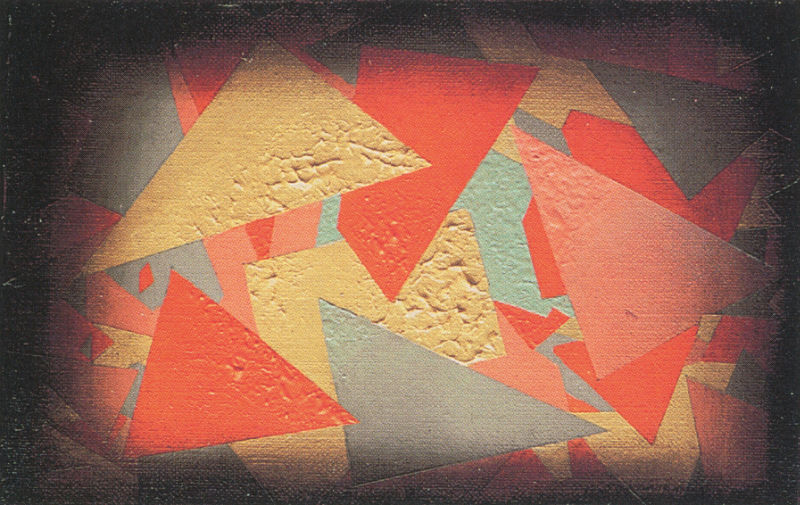
tempera and oil on canvas, 6 x 9 inches
Still, the most engrossing part of People’s Choice has nothing to do with the statistics or the paintings by Komar and Melamid. It’s a collection of answers to this question:
“If you had unlimited resources and could commission your favorite artist to paint anything you wanted, what would it be?”
The replies were gathered at the town halls Komar and Melamid held, and they appear throughout Wypijewski’s book:
“Landscape, or seascape, with ships. Stormy skies darkening (dusk or storm darkness) with sun (indirectly) illuminating portions of the picture. Grays, greens, browns, blues, and blacks.”
“A portrait of my wife with our grandchildren—in their hockey gear. My wife to be done by Modigliani, grandchildren by Ben Shahn.”
“Abstract of scared cats.”
“The home where I grew up in Fairbanks, Alaska, with my ex-seeing-eye dog, Lance, playing off-leash in the front yard in autumn.”
“I’d like a picture that helps, through its beauty and horror, the process of getting to know ourselves. If, in addition, it can be deeply spiritually revealing, better. Thanks for asking.”
These answers read like the prompts that people plug into AI image generators today. There are so many more than the sample I shared here, and each one is like a poem or a snippet of a dream. Each one feels profoundly human.
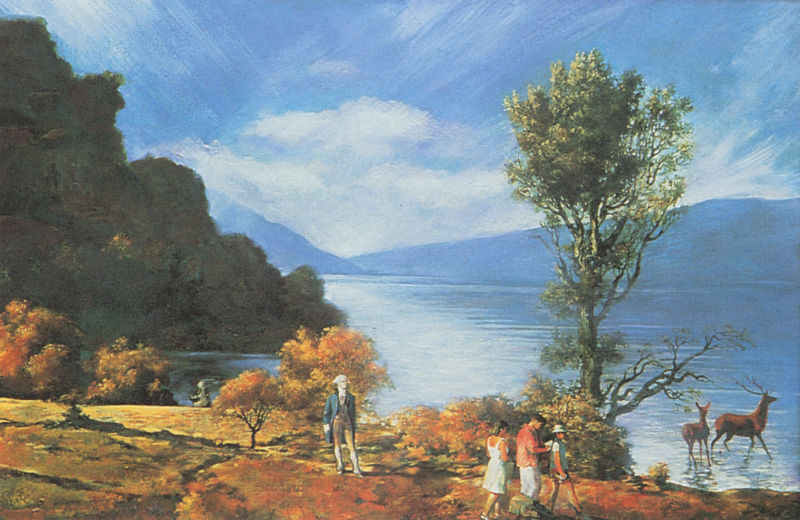
oil and acrylic on canvas, 24 x 32 inches
I rarely make paintings like this one by Komar and Melamid, depicting America’s favorite things in art in the 1990s.
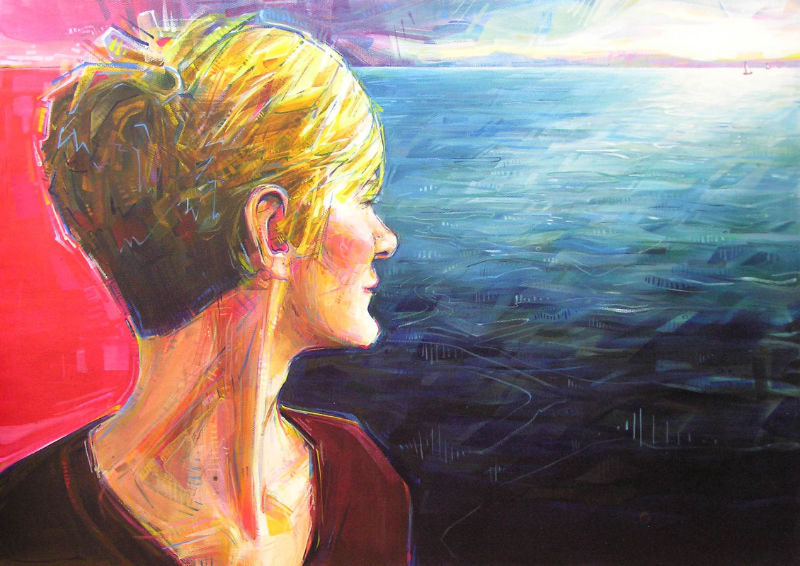
After: She Can Call Herself a Woman
2007
acrylic on bird’s eye piqué
34 x 48 inches
(Part of a series about what it means to be a woman.)
The first time I came close was with this self-portrait in 2007, before I discovered Wypijewski’s book. I’ve made a few other blue landscapes with figures over the years, including this Madonna and child, this self-portrait as a kid, and this painting of a polar bear, but if I had to sum up my art as a whole, I’m proud to say it wouldn’t be “blue landscape” but “rainbow magic animals.”
In other words, I averted the all-too-common artistic trap of people pleasing—a trap that Komar and Melamid’s findings might tempt a lot of artists into. (You can avoid it too if you follow these two bits of advice.)
At the end of last year though, I finally did end up making this blue landscape. It’s based on a collage of photos I’d taken of the Delaware, and this river view is one side of a larger piece called First Steamboat for Passengers and Freight, which was commissioned as part of the 52 Weeks of Firsts public art exhibit.
Working on this landscape is what made me think of Komar and Melamid. It’s why I checked out Wypijewski’s book again.

First Steamboat for Passengers and Freight
2025
acrylic on one side of a foam sculpture in the shape of a #1
44 x 29 x 18 inches
After rereading it, I’m left wondering: would “blue landscape” still be the unifying art theme worldwide if the surveys were done today? Or have cat memes and AI slop so thoroughly infiltrated our minds that there’s no room left for what Melamid calls “the paradise within”?
PLEASE NOTE
I’m a lover of surveys and statistics. I tried making a survey of my own a while back, and I think about this scientific way of understanding taste all the time. Plus, I’m currently obsessed with a recent finding that 96% of Americans agree that arts participation builds wellbeing in their community.
Maybe this post made you think of something you want to tell me? Or perhaps you have a question about my art? I’d love to hear from you!
To receive an email every time I publish a new article or video, sign up for my special mailing list.
If you enjoyed this post, Ko-fi allows you to donate. Every dollar you give is worth a bajillion to me!