Blog / 2025 / My New Project
May 29, 2025
Contact me with suggestions and support the project through Ko-fi or Patreon.
The original painting of Fannie Lou Hamer isn’t for sale at this point, since I’m still figuring out what this project will look like, but you can buy prints here.
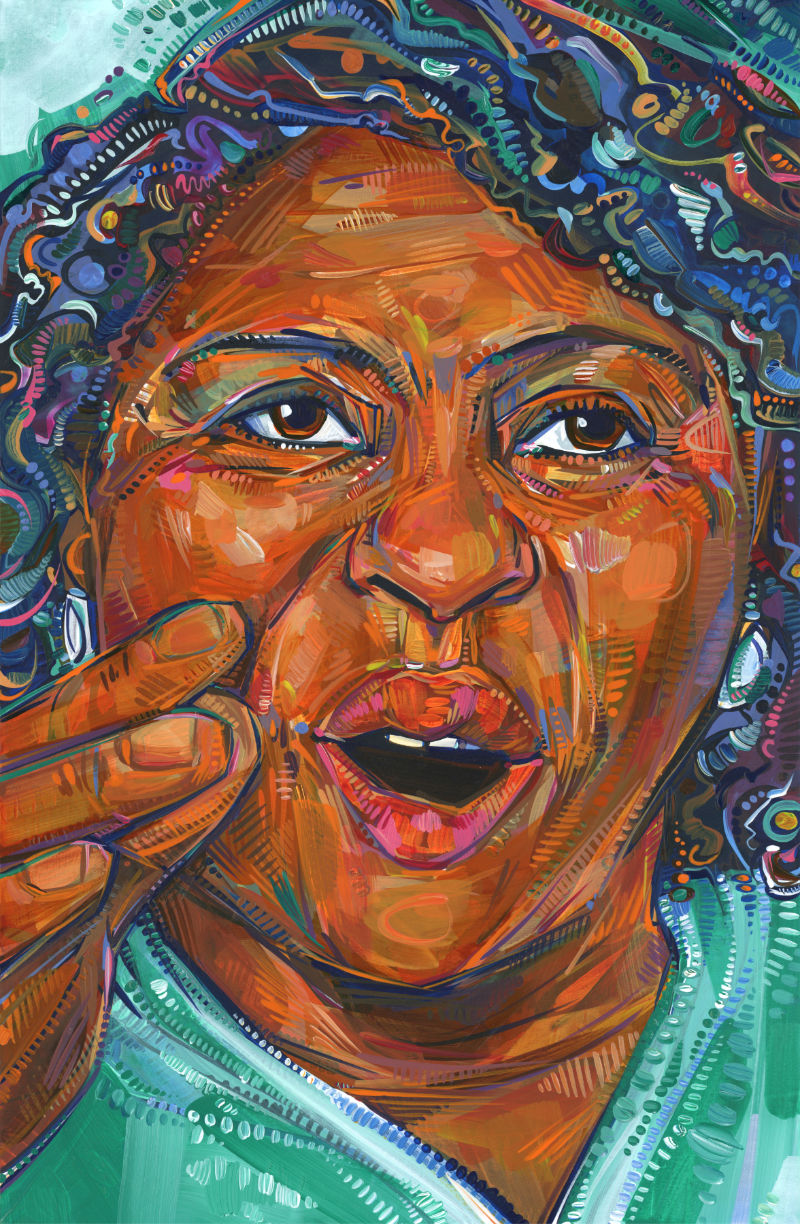
Fannie Lou Hamer
2025
acrylic on archival board
17 x 11 inches
VIDEO TRANSCRIPT
I’m working on a series of portraits of people from American history that the Trump administration would like to erase from historical sites, from public websites, from textbooks, and from history books. I’m talking about people like Fannie Lou Hamer.
Along with these painting that I’m going to be making of these people, I want to include a text, some short story from their lives—nothing that tells the full breadth of who they are, but something that is hopefully gripping enough that it makes you want to learn more about who these figures are.
So, today I’m going to show you the making of this painting, which may or may not be the final painting of Fannie Lou Hamer for this series. I haven’t totally decided on a lot of things about this series, including the format for the full series, but I’m just starting to explore it. So I’m going to show you the making of this painting and I’m going to read to you the text about Fannie Lou Hamer that I have written.
President Lyndon Johnson cut in with an impromptu press conference right as Fannie Lou Hamer’s testimony began. A famously powerful speaker, Hamer was a former sharecropper who’d been evicted from her home, fired from her job, arrested, and beaten for registering to vote in Mississippi. When the broadcast of the Presidential address interrupted Hamer’s speech, she’d just started telling her story to the Credentials Committee of the Democratic National Convention, in a meeting in Atlantic City, New Jersey, that was being transmitted on live television.
Hamer was one of several individuals, including Martin Luther King Jr, who were there to ask that the committee dismiss the group of all-white delegates that Mississippi’s regular party organization had sent. Instead they wanted the committee to recognize the Mississippi Freedom Democratic Party and its group of Black and white delegates as the states’ official representatives at the DNC.
Aware that many white Americans feared the Mississippi Freedom Democratic Party and the integration it embodied, Johnson opposed the seating of Hamer and her cohort at the DNC. Right as Hamer’s testimony began, the President called a press conference from the White House. TV stations cut away from Hamer to cover the President, expecting him to announce his running mate, but Johnson only declared that, on that day nine months ago, the governor of Texas had been shot along with President John F Kennedy. This marker of a seemingly arbitrary monthiversary silenced Hamer in that moment, but, later that evening, major news networks played her moving testimony.
I’d love your help in making this project happen. Please send me the names of historical figures who inspire you. People who care about diversity and equite and inclusion and belonging. People also who are dead, because I am limiting the scope of this project in that way for questions of image permissions, but also because the dead can’t speak for themselves, so I would like for us to speak for them in our way.
If you want to support this project financially, you so on a one-time kind of basis through Ko-fi or you can support my work automatically every month through Patreon. Every donation—no matter what size it is—makes a huge difference to me.
Maybe this post made you think of something you want to tell me? Or perhaps you have a question about my art? I’d love to hear from you!
To receive an email every time I publish a new article or video, sign up for my special mailing list.
If you enjoyed this post, Ko-fi allows you to donate. Every dollar you give is worth a bajillion to me!